
Glacier National Park with Kids – Our Montana RV Road Trip Guide
Updated: Feb 19
Montana feels different the moment you enter it. The towns grow farther apart, the skies stretch wider, and the road begins to move through an almost endless landscape of quiet open land. Wherever you arrive from Wyoming, Washington State, or a small regional airport somewhere in Montana the journey north slowly becomes part of the experience itself. And then, at the very northern edge of the state, near the Canadian border, Glacier National Park appears.
We had already visited many of the great national parks of the American West, but Glacier felt different from the start. Wilder. Larger. Less predictable. It’s a place of turquoise lakes, roaring waterfalls, alpine meadows filled with wildflowers, and wildlife that can appear just steps from the trail. But it’s also a park that asks for more planning than most, especially when traveling with small kids and an RV.
Permits, road restrictions, shuttle systems, seasonal closures, and five completely different regions inside one park can easily feel overwhelming at first. And yet, after spending ten unforgettable nights around Glacier, it became one of the most powerful and meaningful stops of our entire family journey across the United States.
This guide brings together everything we learned along the way: how to reach Glacier from different directions, where to stop in Montana before entering the park, how to plan Glacier with kids and an RV, and the exact places inside the park that made this experience so special for our family.
If you’re dreaming about visiting Glacier National Park with children, this is the road, the plan, and the story that will help you get there.

How to Get to Glacier National Park with Kids and an RV
Montana is vast, and reaching Glacier is part of the adventure.
Unlike some national parks that sit just outside major cities, Glacier lies far to the north near the Canadian border and surrounded by long, quiet stretches of open land.
You can arrive here from several directions. Some families drive north from Wyoming and Yellowstone (the route we chose). Others come from the west, crossing Idaho or Washington State. And many visitors choose to fly into Kalispell (Glacier Park International Airport), the closest and most practical gateway to the park, where renting an RV or car makes it easy to explore at a slower, family-friendly pace.
We reached Glacier from the south after days on the road, watching Montana slowly open up around us until the mountains finally appeared on the horizon.
Breaking the Long Drive North
The road from Yellowstone to Glacier is long, nearly 400 miles, and it’s also a slow drive that can take more than seven hours. For families traveling with kids, splitting this stretch into smaller, meaningful stops can completely change the experience.
We highly recommend stopping along the way and even spending a night or two somewhere in between.
One natural first pause is Bozeman, a relaxed college town with cafés, parks, and the Museum of the Rockies, home to one of the world’s most impressive dinosaur collections. Even though we didn’t visit ourselves, we heard many good things about it. Stopping here for a few hours, together with a breakfast or lunch break, can be a great midway stop for kids.
Farther along the route lies Helena, Montana’s small but lively capital and a peaceful place to split the drive in two and spend the night. If you have extra time, it’s also a wonderful place to stay longer. The city is surrounded by quiet lakes, simple campgrounds, and the vast Helena–Lewis and Clark National Forest, offering space to slow down, walk, and breathe after the intensity and crowds of Yellowstone.
Black Sandy State Park - A Peaceful Pause by the Lake
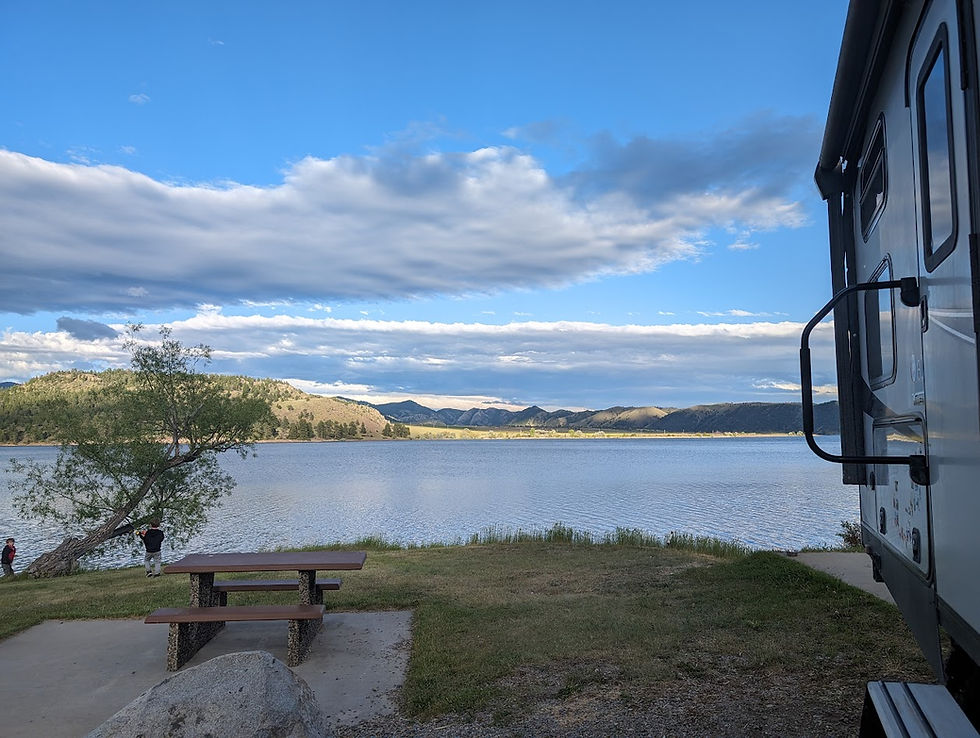
Our stop here was at Black Sandy State Park, about a 25-minute drive from Helena, and it turned out to be exactly what we needed. The campground sits beside a beautiful lake, surrounded by open land and soft Montana light.
We spent three nights here, with long mornings by the water, quiet afternoons letting the kids play, and simple evenings watching the colors shift across the lake. We also drove into Helena to restock groceries, refill supplies, and even catch a movie with the kids, small everyday moments that become surprisingly meaningful during a long family road trip.
Important things to know before choosing Black Sandy State Park:
It’s beautiful, quiet, and relaxing but also a simple campground, not a full-service RV resort.
Cell reception is very limited, which can feel peaceful or inconvenient, depending on your perspective.
Access is via a dirt road that can become very muddy after rain.
Farther north you can also stop in Great Falls, where the Lewis and Clark Interpretive Center and wide Missouri River viewpoints add a historical layer to the journey. We heard good things about this stop, but it requires a slight detour from the main route, which is why we chose to skip it this time.
However you choose to travel, this stretch of Montana is not just a drive between parks. It’s the gradual transition from the busy geothermal world of Yellowstone to the raw, quiet scale of Glacier.
Take your time. Slow down. Breathe the experience fully and arrive rested and peaceful, the exactly right state of mind to meet the extraordinary beauty of Glacier National Park.
Planning Your Glacier Visit with Kids and an RV
Glacier National Park is one of the most breathtaking places in the United States, but it is also one of the most complex to plan, especially with small kids and an RV.
Glacier is divided into five different regions, and access rules change by area. Some scenic roads limit vehicle size, timed-entry permits apply in certain areas and seasons, and weather can keep key routes closed well into early summer.
The good news is that once you understand how the park is divided, planning becomes much simpler. Instead of thinking about Glacier as one destination, it helps to see it as five different regions each with its own landscape, access rules, and family-friendly experiences.
That’s exactly how we explored the park, and in the next sections we’ll walk through each region step by step, sharing what worked best for our family on the road.
Before diving into the regions themselves, we strongly recommend checking the official Glacier National Park website for the most up-to-date information about permits, road access, and seasonal conditions.
You can find it here: https://www.nps.gov/glac/index.htm
It is also worth reviewing the park’s live directions and road status map, which shows closures and access changes that can shift daily depending on weather and snow conditions:
A few minutes there can save hours of confusion once you arrive.
Glacier’s Five Regions:
Two Medicine – The Quiet Side of Glacier
Coming from the south, Two Medicine is usually the first part of Glacier National Park you reach. After the long drive north through Montana, arriving here feels like a quiet doorway into the park, wide open water and mountains rising calmly in the distance.
Compared with other regions of Glacier, Two Medicine is smaller, slower, and far less visited. There are fewer crowds, shorter distances, and a natural rhythm that makes it especially comfortable for families traveling with kids and an RV. Because of that, it works beautifully as either a starting point or a gentle ending to a Glacier journey.
If Glacier has a place that still feels untouched and calm, it is Two Medicine. Many visitors skip this area and head straight to the more famous parts of the park, but in our opinion that is a mistake. Even a half day here by the lake can feel deeply rewarding.
Two Medicine offers a quieter experience, calm lakes, and trails that feel close to nature from the very first step. For families with young kids, it is one of the easiest and most relaxing places to explore in the entire park. You can arrive, park, walk just a few steps, and already find yourselves standing beside a beautiful alpine lake.

We chose to spend our first night in Glacier here at Two Medicine Campground, a more raw and simple campground without hookups and we loved it.
We arrived in the afternoon, set up camp, and walked straight to the lake. After about twenty minutes of simply absorbing the view, we began the Aster Falls Trail, which starts right from the lakeshore. The waterfall at the end is not dramatic or unique, but the trail itself is beautiful, mostly flat, lined with wildflowers in early summer, and perfect for walking with small kids at an easy pace.
On our way back near sunset, we spotted two massive moose grazing in a small pond beside the trail. Moments like this are the reason to walk early in the morning or toward evening, wildlife activity is simply much higher at those hours.

We had planned to continue to Paradise Point on the way back, but darkness was already falling and we had to skip it. From what we heard, it is a wonderful viewpoint over the lake and worth adding if timing allows.
The next morning we spent slow, peaceful hours on the lakeshore, a simple picnic breakfast, kids running freely, and nothing to do except watch the light move across the water. It was a gentle, beautiful visit and a place we highly recommend not skipping.
From Two Medicine, we continued north toward Many Glacier.
The fastest route leads toward St. Mary Lake is via Highway 89, but it is important to know that this direct road is limited to vehicles under 24 feet.
Because of our RV length, we had to detour through the town of Browning instead of taking the shorter route.
In the end, it was not a real inconvenience. The detour gave us a good chance to refuel and restock, and the extra driving time was minimal.
Many Glacier – The Wild Heart of Glacier National Park
If Two Medicine feels like a quiet doorway into Glacier, Many Glacier feels like stepping straight into its wild heart.
This is the part of the park where the mountains rise higher, the lakes stretch deeper into the valleys, and the sense of raw nature becomes impossible to ignore. For many visitors, this is not just another region inside Glacier, it is the place they remember the most.
Trails here lead toward glaciers, alpine lakes, and dramatic viewpoints. Wildlife sightings are common and the scale of the landscape feels larger and more powerful than almost anywhere else in the park.
We chose to spend four nights in this area, giving ourselves enough time to explore slowly, hike without rushing, and let the experience unfold at a family pace.
Many Glacier quickly became one of the most meaningful parts of our entire journey across the United States.
Not because of a single viewpoint, not because of one famous trail, but because of the feeling of being surrounded by nature that is still vast, unpredictable, and deeply alive.
In the days we spent here, we discovered some of the most beautiful family-friendly hikes in Glacier National Park.
We stayed at Chewing Black Bones Campground, a simple lakeside campground that may not look impressive at first glance, but its location makes it one of the most practical bases for exploring both Many Glacier and St. Mary Lake.
The campground is quiet, relatively affordable, and sits right beside open water and wide Montana skies. For families traveling with an RV, that balance between access, space, and calm turned out to matter far more than polished facilities.
What to Do in Many Glacier:
Redrock Falls – One of the Most Rewarding Family Hikes in the Area
Redrock Falls is probably one of the most rewarding family-friendly hikes in Many Glacier, relatively easy while still feeling truly wild and beautiful.
The trail is mostly flat and shaded by forest, leading to gentle waterfalls at the end. But the real beauty is in the journey itself: towering trees, open alpine views, and the calm rhythm of walking slowly through the valley.
For families with small children, this hike is a great experience. You can move at an easy pace, stop whenever you like, and simply enjoy being surrounded by nature.
The full out-and-back distance to the falls is about 3.5–4 miles round trip (≈5–6 km), but because it is not a loop, you can always turn around earlier if needed. We packed lunch, walked slowly with many stops, and reached the waterfalls with the kids feeling very satisfied.

Grinnell Glacier Trail – The Signature Hike of Many Glacier
Grinnell Glacier Trail is widely considered one of the most beautiful and iconic hikes in Glacier National Park. We were told that if you have time for only one major trail in the park, this is the one to choose and after experiencing it ourselves, we completely agree.
When we visited in the final ten days of June, snow conditions meant that only about two-thirds of the trail was open. We could not reach the glacier itself, but the viewpoint overlooking Grinnell Lake from above was breathtaking and absolutely worth the effort.
The first section of the trail passes through stunning forest, followed by a steady and sometimes steep climb that opens into dramatic alpine scenery.
Because of the distance and elevation, we do not consider this a suitable hike for small children. Instead, we hiked it in turns, one parent in the morning, the other later in the afternoon. This became one of the best strategies of our entire long family road trip: the kids rested, and each of us enjoyed meaningful solo time in nature.
It is also important to note that this recommended route is the upper trail overlooking Grinnell Lake, not the lower path that leads directly to the lake itself. In our opinion, the elevated views are far more impressive than reaching the shoreline.
Another option here is the boat shuttle departing from Many Glacier Hotel, which can shorten a large flat section of the hike and bring you close to the climbing point. However, reservations usually need to be made well in advance, the cost is relatively high, and using the boat one way often creates logistical challenges returning to your starting point. For many, simply hiking the beautiful lakeside section without the boat is the more practical and enjoyable choice.

Swiftcurrent Lake – Quiet Moments Between the Trails
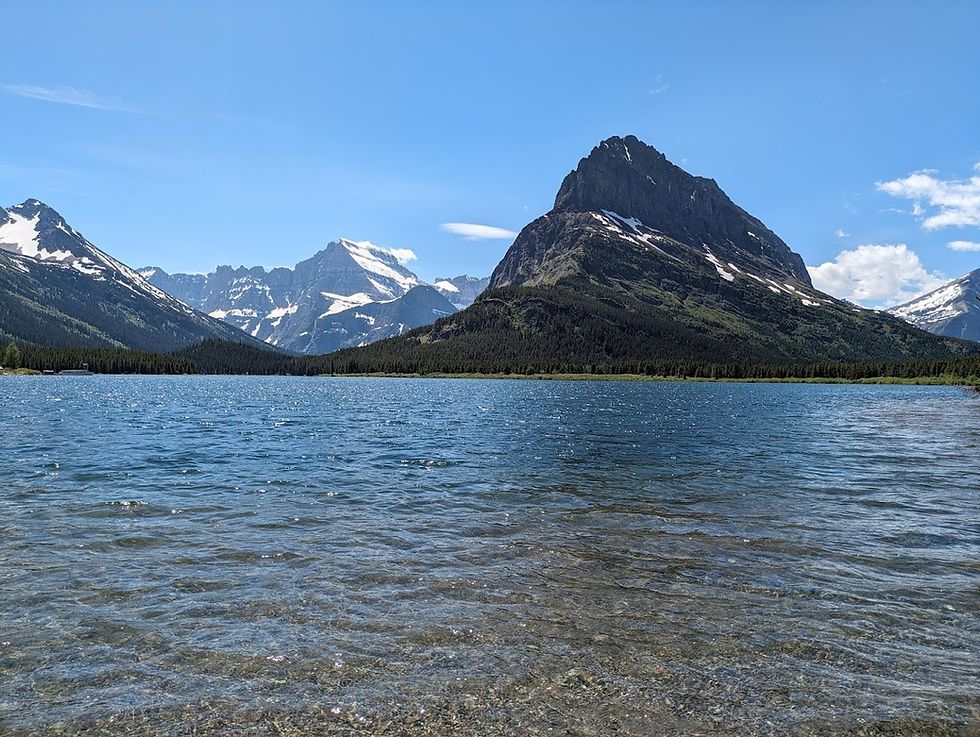
Not every meaningful moment in Glacier happens on a major hike. Some of our most memorable experiences in Many Glacier came from simply sitting beside Swiftcurrent Lake, watching the changing light over the water.
Kayaks and paddleboards can be rented near Many Glacier Hotel, in the same area where boat tickets are sold. At the northern edge of the lake, there is also a small quiet shoreline where it is possible to sit quietly and enjoy the scenery.
Walking around the lake is beautiful in itself, and the first flat section of the Grinnell trail actually begins here. If you are not planning to hike all the way to Grinnell Glacier, we highly recommend at least walking this peaceful lakeside segment through forest.
Iceberg Lake Trail – A Longer Adventure to Consider
Iceberg Lake is often described as one of the most stunning alpine lakes in Glacier. We did not manage to hike this trail during our stay, mainly because of distance and difficulty with young children, but it is frequently recommended for travelers looking for a longer and more challenging experience in Many Glacier.
For families with older kids or extra hiking time, this trail is well worth considering.

St. Mary Lake – Lakes, Wildflowers, and Waterfalls
From Many Glacier, we continued south to the next area, St. Mary Lake, which also marks the eastern edge of the famous Going-to-the-Sun Road.
This area is quite close to Many Glacier, so we visited it while still camping at the same spot at Chewing Black Bones Campground. While it is possible to spend several days here, we think that a full, long day can absolutely be enough.
It is important to understand that the visitor center at St. Mary Lake is what many people refer to as the end of Going-to-the-Sun Road. Of course, it can also be the beginning, but most visitors start from the opposite side near Lake McDonald visitor center.
In our opinion, driving the entire road in a single day would be a mistake. There is simply too much to see and experience here. We strongly recommend splitting the road into two days, using Logan Pass, the highest point along Going-to-the-Sun Road, as the natural divider between the eastern and western sides of the park.
This strategy is especially useful if you are visiting Many Glacier as well and also because Logan Pass can remain closed even in late June, making a full crossing impossible.
We woke up early, packed breakfast and lunch, and headed to the large visitor center at St. Mary. Here you can take your time to learn a bit about the park with your kids, ask a ranger for the Junior Ranger workbook, which turns the day into a great mix of learning, play, and exploration.
Sun Point Overlook (via the short Sun Point Nature Trail)
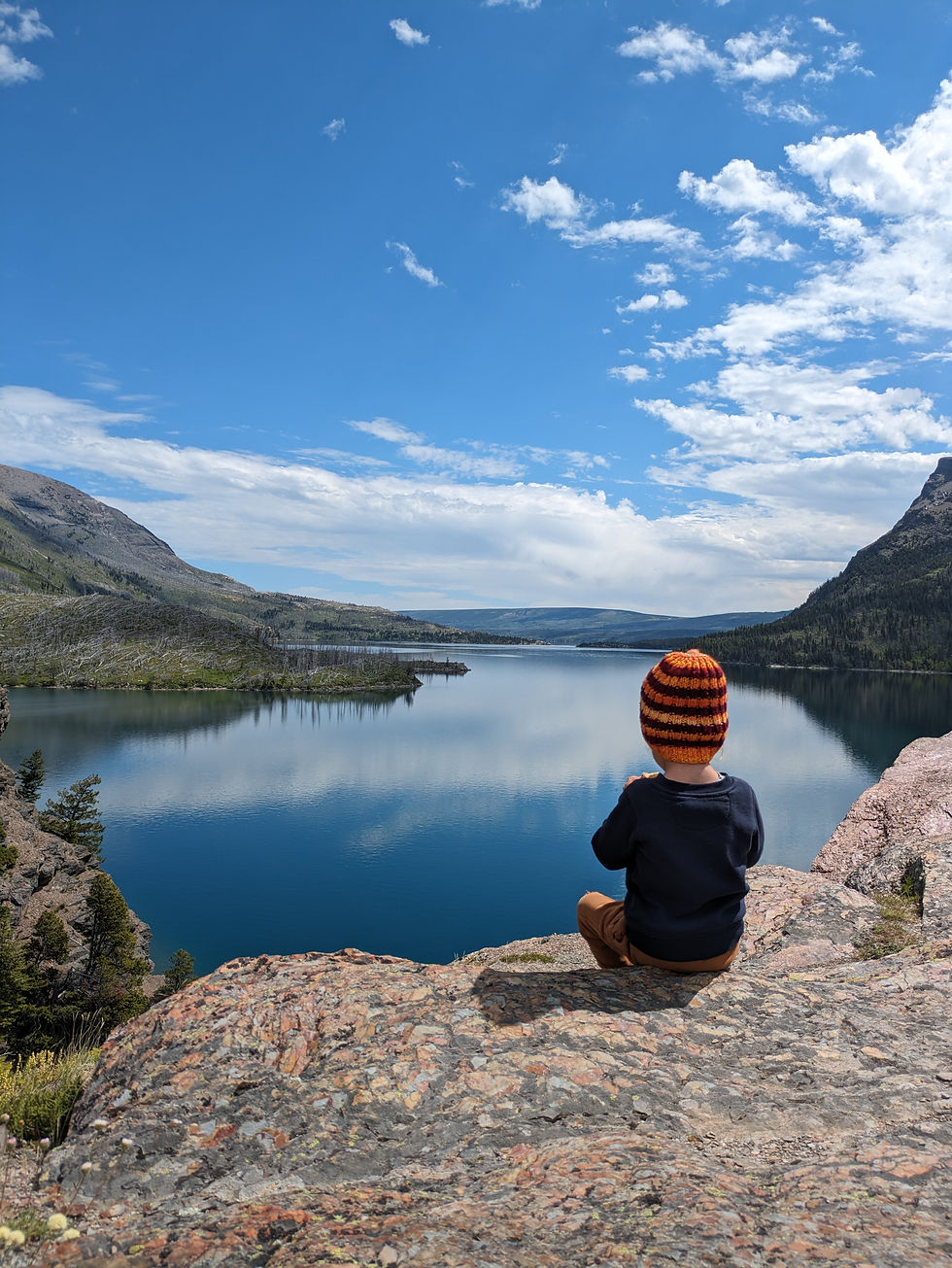
St. Mary Lake itself is beautiful, with several scenic pullouts along the shoreline. Our favorite stop was Sun Point - a breathtaking overlook just a five-minute walk from the parking area.
After climbing the rocks and sitting in front of the wide lake view, this becomes a perfect place for a quiet picnic before continuing the day.
From here, you have two options:
Begin the full trail toward Virginia Falls (about 3.2–3.6 miles / 5–6 km round trip). The hike feels longer with kids and at times demanding, but also incredibly beautiful and we highly recommend it.
Return to the car and drive between the main stops, which is a very reasonable choice when traveling with small kids or limited time.
We chose to walk the entire trail, and although it required real effort, it was absolutely worth it.
Baring Falls
The next stop along the trail is Baring Falls, located roughly in the first third of the route from Sun Point to Virginia Falls.
These are small but charming waterfalls, a pleasant place to pause and rest if you are already hiking the trail. However, if you are driving between stops you can consider skipping them especially compared with the more dramatic waterfalls ahead.
Piegan Pass
This section of the trail becomes truly special in June.
Although the climb here is more challenging, especially with young children, the surrounding meadows explode with wildflowers in every color and shape. It felt less like a hiking trail and more like walking through an endless natural garden, one of the most powerful blooming landscapes we experienced in our trip.
Later in the summer and if the flowers fade, this stretch may be less rewarding, and it is worth confirming at the visitor center before starting the hike.

St. Mary Falls
Further along the route, you reach St. Mary Falls - powerful, beautiful waterfalls that can also be accessed from a nearby parking area.
This means you can:
Stop first at Sun Point for the overlook
Then drive to St. Mary Falls parking
Walk approximately15 minutes and reach the falls.
At the falls we also had a longer stop and had a small lunch break we had packed earlier.
Virginia Falls
The final section of the longer trail climbs steeply above St. Mary Falls and ends at the dramatic Virginia Falls.
From the highest of the three viewpoints, the spray of the waterfall can actually reach you. It is easily one of the most impressive waterfalls we saw anywhere in the United States.
That said, the climb is demanding, especially for young children. There are several smaller waterfalls and many good resting spots along the way, but it is not a hike for everyone, and that is important to consider in advance.

The full trail is beautiful and filled with points of interest, but it is not easy, even though much of it is relatively flat. It required real time, patience, and energy from us.
In June, we strongly recommend hiking the entire trail because of the wildflowers. In other months, we’re not sure whether the wildflowers are still blooming, so it’s worth checking locally before hiking the full trail.
Another option, which we did not try, is to hike one way and attempt to catch a ride back from the St. Mary Falls area to Sun Point, since the road distance between them is short.
An even better solution, if traveling with friends, is to park one car at Sun Point and another at St. Mary Falls, turning the route into a one-way hike and avoiding the long return walk.
Jackson Glacier Overlook
After finishing the trail, we continued driving higher along Going-to-the-Sun Road toward Jackson Glacier Overlook.
On June 22, when we were there, the road beyond this point was still closed due to snow. Just two days later, on June 24, the full road opened, you can never know when it will be open and it is highly important to look at the weather forecast and updates in the park website:
The glacier viewpoint itself was pleasant, though not among the most dramatic stops in the park.
Lake McDonald- The Western Side of Glacier National Park
After five unforgettable days exploring the eastern side of Glacier, we made our way west. Because our RV could not cross the full length of Going-to-the-Sun Road, we had to drive around the park instead, following Highway 464 and then Highway 2.
The pure driving time is roughly three to three and a half hours, but in reality, travel days with an RV are never just about the road. Packing up the campsite, stopping along the way, refueling, checking in at the new campground, and setting everything up again meant that by the time we were settled, it was already late afternoon. We treated this mostly as a transition and rest day before beginning to explore the western side.
We stayed at Mountain Meadow RV Park, a campground we truly recommend. The setting is beautifully forested, peaceful, and conveniently close to the Lake McDonald entrance. We spent four nights here, which felt like the right amount of time for this side of the park.
You can also stay inside the park itself, Apgar Campground near Lake McDonald is one of the most convenient options, especially for travelers planning to use the summer shuttle system. If you don’t have a separate car and are traveling only with an RV, this may be your only practical option for visiting this side of the park.
Staying in Apgar can be a great experience but please note that there aren't any hookups and it is very hard to find a spot.
Most national park campgrounds in the United States, including Apgar, must be reserved through the official booking system at recreation.gov. This platform is often the only way to secure a campsite in advance.
One useful trick we learned during our trip is to set up availability alerts inside the system. When a cancellation appears (and believe it or not, they happen often), you receive an email notification, and if you are the fastest, you can book the spot. Creating alerts from multiple accounts (different email addresses) can significantly improve your chances of finding an open site because you can have more alerts on different parks and dates at once and this strategy worked for us more than once.
Lake McDonald Area
The Lake McDonald region is considered the most central and visited part of Glacier National Park. While we personally found the hikes around Many Glacier more dramatic, this area likely feels more “central” because it includes a major visitor center, seasonal shuttle access beginning in July, and the western entrance to the famous Going-to-the-Sun Road.
At Apgar Visitor Center, you’ll find updated trail information, ranger programs, and family-friendly resources.
Timed-Entry Permit (Important)
A timed-entry reservation is required to enter Going-to-the-Sun Road from the Lake McDonald / Apgar side between 6:00 AM and 3:00 PM, typically from late May through early September (dates vary slightly each year).
Cost: $2 reservation fee
Opens: 120 days in advance
Additional tickets released: 7:00 PM the evening before
You can find the tickets at https://www.recreation.gov/timed-entry/10087086
RV Restrictions on Going-to-the-Sun Road
Vehicle size limits apply on the alpine section of the road (between Avalanche Creek and Rising Sun):
Maximum length: 21 feet
Maximum height: 10 feet
Maximum width: 8 feet (including mirrors)
Even if your RV technically fits, the narrow cliffs and tight turns make the drive extremely stressful. In practice, most RV travelers explore this area using the park shuttle (from July) or a separate passenger vehicle.
Going-to-the-Sun Road – West to Logan Pass
This legendary scenic road begins near the visitor center and runs along the southern shore of Lake McDonald, offering numerous pullouts for lake views and picnic stops. Beyond the entrance gate, the road climbs steadily into the alpine heart of the park.
Here are the main stops we recommend along the western ascent:
Trail of the Cedars
One of the most beautiful and accessible walks in Glacier. Although part of the trail is on a wooden boardwalk, the towering ancient trees and deep forest atmosphere are breathtaking. This was easily one of the most powerful and memorable family-friendly short walks of our entire trip and our number one recommendation for families with kids in the entire Glacier National Park.

The Loop & Highline Trail Access
Partway up the climb, the road reaches The Loop, a scenic viewpoint and the endpoint of the famous Highline Trail (12 miles from Logan Pass).
Families will not hike the full Highline but can still walk one or two miles of its end, starting from The Loop for impressive alpine scenery before turning back and continue the ride up. The view here is nice and there is a big chance that you will be here by your own but note that this trail is highly exposed to the sun and in noon on hot days it can feel quite difficult.
Scenic Overlooks
There are many viewpoints on your way to Logan Pass, our favorite was:
Bird Woman Falls Overlook
Paradise Meadow
Oberlin Bend
Each offers dramatic mountain scenery and is well worth stopping for.
Logan Pass & Hidden Lake
Logan Pass is the highest point on Going-to-the-Sun Road and the natural divider between Glacier’s east and west sides. There is a very nice visitor center here, and for travelers crossing the entire road, this marks the beginning of the descent toward St. Mary.
Before leaving Logan Pass, we highly recommend visiting one of Glacier’s most beloved trails:
Hidden Lake Trail
This hike has two sections:
A shorter walk to the overlook
A longer continuation down to the lake shoreline
When we arrived in late June, the area was still deeply covered in snow. Although some hikers continued toward the lake, we chose instead to wander through the snowy landscape, play, build a snowman, and simply enjoy the moment. For the kids, this became one of the most joyful memories of the entire park.
From here we turned back toward Lake McDonaldand then back to our campground for dinner. This is a long day, and although the drive is gorgeous, it is slow and demanding, so take your time and drive safely.
A Quiet Surprise on Lake McDonald – Rocky Point
On the next day we decided to explore the other side of Lake McDonald where most don't arrive. This northern shore of Lake McDonald, requires no permit and has no vehicle size restrictions.
Rocky Point Trail
The trail itself is pleasant, and the official viewpoint is nice but for us the real magic lies just before it.
At the small hidden shoreline near 48°33'08.6"N 113°58'32.8"W, we found a tiny, peaceful beach where we spent an entire afternoon resting by the water. The kids played in the lake, we shared a quiet picnic, and the crowds of the main road felt very far away. It was just us, the amazing lake, a few birds, and endless quiet. If you’re looking for a calm, intimate moment in Glacier, this is a place we warmly recommend.
Here at this side we had a great day and it is important to say that not all the beautiful places and unique experiences in Glacier sit along the famous road.
If you have the time we highly recommend to explore, you can ask for a less crowded hike in the visitor center or find a new spot on the lake nobody ever wrote about.

North Fork – The Wildest Corner of Glacier
The far northwestern edge of Glacier National Park, known as North Fork, is a region we did not reach during our journey but it remains one of the park’s most remote and least-visited areas.
This part of Glacier feels noticeably more rugged and untamed, with long gravel access roads, minimal services, and a slower wilderness rhythm.Two of the most well-known destinations here are Bowman Lake and Kintla Lake, both surrounded by deep forest and quiet mountain scenery that offer a very different experience from the busier eastern valleys.
Several backcountry and lakeside trails begin from these areas, including routes along Bowman Lake’s shoreline and longer wilderness hikes deeper into the park, places often chosen by travelers seeking solitude rather than iconic viewpoints.
During peak season (typically late May through early September), vehicle entry reservations are required for the North Fork area, similar to other parts of Glacier, and some campgrounds operate on a first-come-first-served basis, making advance planning especially important.
Although we spent nearly two full weeks exploring Glacier and never felt that anything essential was missing, this is one corner of the park we would likely visit on a future trip especially without small kids and with more time for slower wilderness hiking.
Beyond the Border – Waterton Lakes, Canada
Just across the northern border lies Waterton Lakes National Park in Canada, which together with Glacier forms the Waterton–Glacier International Peace Park, a quieter and wilder continuation of the same landscape.
Is Late June the Best Time to Visit Glacier?
For us, visiting Glacier at the end of June felt like a perfect balance.
Crowds were significantly lighter than peak summer, most areas were already open, and we were lucky enough to see Going-to-the-Sun Road open just in time. There was no shuttle system operating yet, which can be less convenient, but it also meant fewer visitors overall and a quieter experience on the trails.
The weather was ideal, and the wildflower bloom was simply spectacular, some of the most beautiful spring landscapes we saw anywhere during our entire journey across the United States.
If you are traveling with an RV and not, like us, traveling with a pickup truck and a travel trailer, Glacier in late June, especially the Lake McDonald side, requires some planning. You may need to either:
Arrive later in July when the shuttle operates.
Focus primarily on the eastern side of the park.
Skip the alpine section of Going-to-the-Sun Road.
Rent a regular vehicle for a day.
That said, we truly believe Glacier is worth visiting even if you cannot drive the full scenic road. Many of the most powerful landscapes and hikes mentioned here are accessible without crossing the entire alpine section.
If you are considering a late-June visit, we would not hesitate. Glacier is one of the most breathtaking national parks we have experienced, a serious contender for the most beautiful park in the United States, at least in our eyes.
Glacier is not just another national park. It is wild, powerful, and humbling in a way that stays with you long after you leave. As we packed up and continued east, we knew this was not really goodbye, just the end of one unforgettable chapter.
Driving South-West to Idaho and Washington
Just before closing this chapter, it’s worth remembering that you are still in Montana, and the journey west holds a few quiet surprises of its own.
We continued south for a final overnight stop at Watchdog Winery, a peaceful Harvest Hosts location surrounded by open landscapes and vineyards. It turned out to be a relaxing and beautiful single-night stop, with a chance to meet a very nice family, learn about winemaking, and of course enjoy great wine.
The road itself, especially along Flathead Lake, was unexpectedly stunning, wide blue water, rolling farmland, and endless yellow canola fields stretching toward the mountains. Even without a formal attraction, this stretch felt like a gentle and meaningful goodbye to Montana.
From here, we continued west toward Idaho and eventually Washington. Because it is a very long drive, we stopped for a few nights at Benewah Lake Campground, a lovely campground in Heyburn State Park.
We then spent one more night at Iron Horse Brewery – Worldwide HQ, which turned out to be one of the best Harvest Hosts stays of our entire trip.
From there, we continued to Mount Rainier National Park in Washington, a total of about 600 miles (≈965 km) and roughly 10 hours of driving.
And just like that, our Montana chapter came to an end, not with a single moment, but with a quiet collection of mountains, lakes, long roads, and family memories that slowly became something much bigger.
Glacier is not just another national park.
It is wild, powerful, and humbling in a way that stays with you long after you leave.
As we drove west toward the next chapter of our journey, we knew this wasn’t really goodbye
just the end of one unforgettable part of the road.

Plan Your Glacier National Park Visit – Maps and Trails
Want a quick, organized list of all the lakes, viewpoints, hikes, and scenic stops we mentioned in this guide?
To make planning easier, we’ve put everything in one place:
• A public Google Maps with every point of interest 👉 Open here
• A full AllTrails list with all the hikes in one place 👉 View here
So you can easily save, navigate, and plan your own Glacier family adventure.
Planning more national park adventures with kids?
Glacier was one of the highlights of our RV journey but it’s part of a much bigger road trip we did across the USA.
👉 Read our full guide: Not the Usual Suspects -5 Best National Parks to Visit with Kids on an RV Trip


Comments